
The short answer: Most agencies fail local businesses because the business model is misaligned: hourly billing rewards slow work, retainers reward activity over outcomes, and reporting hides behind vanity metrics. A good marketing agency for local business engagement is the opposite — bounded in writing, priced on outcomes instead of hours, measured on leads and revenue, with you owning every asset.
Ask a local business owner about their experience with marketing agencies and watch their face. There’s a specific expression — a mix of exhaustion and embarrassment — that appears almost every time. They’ll tell you about the $2,500-a-month retainer that produced a new logo and a blog post about “10 Reasons to Love Fall.” They’ll tell you about the SEO company that sent twelve-page reports for two years while the phone stayed quiet. They’ll tell you about the ads manager who burned through five figures while blaming “the algorithm.”
Then they’ll say the sentence you’ve heard a hundred times if you’ve been in this world: “Marketing just doesn’t work for businesses like mine.”
Marketing works fine. What doesn’t work is the way most agencies sell it to local businesses. The failure isn’t in the tactics — SEO, ads, content, all of it can work. The failure is in the engagement model: how agencies charge, what they measure, who owns what, and whose incentives point where. Get the model wrong and even competent tactics die. Get it right and average tactics can win.
This post is about the model. Why the standard agency arrangement fails local businesses with grim regularity, what the failure looks like from the inside, and — more usefully — what a good engagement actually looks like, so you can demand it or walk away from anything less.
The Misalignment at the Heart of the Retainer Model
Everything starts with incentives. An agency on a monthly retainer gets paid the same whether your phone rings or not. Let that sit for a moment, because it explains nearly every frustration you’ve ever had with an agency.
The retainer model pays for activity, not outcomes. The agency’s rational move — and agencies are businesses, they respond to incentives like everyone else — is to deliver the maximum appearance of activity at the minimum cost of effort. That means: a flurry of deliverables early on (audit! strategy deck! new homepage mockup!), then a long, comfortable cruise of low-effort maintenance. A blog post a month. A report a month. A check-in call where someone reads the report to you.
Meanwhile, the things that would actually move your revenue — rebuilding the lead capture, fixing the follow-up speed, testing offers, publishing content that ranks — are effort-intensive and risky. If the test fails, the agency has to explain a failure. If they just keep publishing the monthly blog post about fall, there’s never a failure to explain. The retainer rewards the safe, the routine, and the cosmetic. It punishes the bold, the experimental, and the effective.
This isn’t a conspiracy. Nobody at the agency is twirling a mustache. It’s just what the incentive structure produces, the way a river produces a canyon — slowly, inevitably, without malice. The account manager isn’t lying when she says she’s “working hard on your account.” She’s working hard on the things the retainer rewards. Your revenue was never in the job description.
Reporting Theater: How Agencies Hide Behind Vanity Metrics
Every misaligned retainer needs a cover story, and the cover story is the monthly report. You’ve seen it: twelve pages of charts, all trending reassuringly upward, concluding with “great momentum this month!” while your bank account tells a different story.
Reporting theater works because of a simple asymmetry: the agency chooses what’s measured. And what gets measured is whatever looks good. Impressions, reach, clicks, keyword rankings for obscure long-tail phrases, “engagement rate,” social followers — the full parade of metrics that can improve indefinitely without producing a single customer.
Here’s the test we give every business owner: take your last agency report and try to answer three questions from it. How many leads did we get? What did each lead cost? How many became customers? If the report can’t answer those three questions — the only three that determine whether the money was well spent — then the report isn’t a report. It’s a retention device. Its job is to make canceling feel like quitting on “momentum.”
The tragedy is that the real numbers usually exist. The agency has the ad spend data. The website has the form submissions. What’s missing is the will to connect them into an honest picture, because the honest picture is sometimes ugly, and ugly pictures get retainers cancelled. So the report shows you the weather instead of the bank balance, and everyone politely pretends that’s analysis.
A serious engagement reports on business outcomes first and tactics second. Leads, cost per lead, booked appointments, revenue attributed — the numbers from our marketing dashboard guide. Everything else is appendix material. If your agency won’t report this way, it’s worth asking what they’re afraid you’ll see.
The Hourly Trap
Some agencies bill by the hour instead of by retainer, and the trap is the same shape with a different label. Hourly billing rewards slow work. The longer a task takes, the more it pays. There is no incentive to be efficient, to productize, or to finish — and every incentive to discover that a simple job somehow required fourteen hours of “strategy.”
Fixed prices for defined deliverables flip that incentive. The builder’s profit comes from the gap between the price and their cost, so efficiency and excellence pay. You’ll never see an invoice for “miscellaneous hours” or “strategy alignment sessions.” You pay for the machine, not the time spent thinking about the machine.
The Generalist Problem: Agencies That Serve Everyone Serve No One
Generalist agencies sell “full-service digital solutions for forward-thinking brands” — which is a way of saying they have no pattern to repeat. Every client is a new learning curve, every deliverable is custom, and quality depends entirely on who happens to be assigned to you. Specialists have patterns; generalists have meetings. A provider who says “we do lead machines for home service businesses” has done it enough times to know what works. A provider who does everything has done nothing often enough to systematize it.
The Churn Machine: Why Agencies Need You Confused
Here is where the original version of this post overstated its case, and the correction matters. It claimed the average agency-client relationship lasts well under two years. That is not what the best available data says — at least, not as a general average.
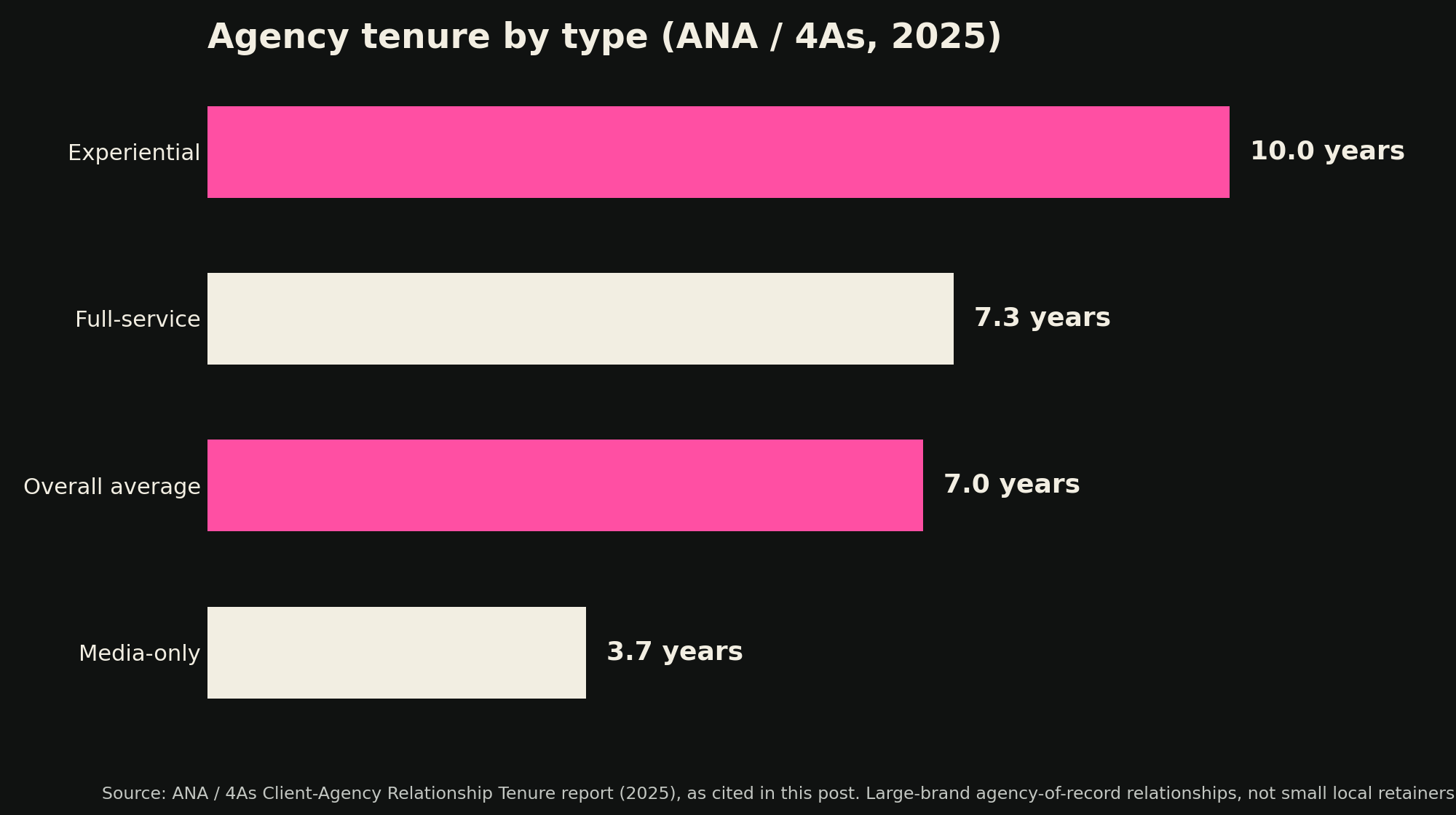
The Association of National Advertisers (ANA) and the American Association of Advertising Agencies (4As), in their 2025 Client-Agency Relationship Tenure report, found the average client-agency relationship now stands at approximately seven years, more than double the 3.2-year average reported in 2016. Full-service integrated agencies averaged 7.3 years; media-only agencies averaged 3.7 years; experiential agencies averaged about 10 years. Those are large-brand agency-of-record relationships, not small local retainers — so they do not prove that your local agency relationship will last seven years. But they do mean “well under two years” cannot be stated as the average.
What the data does support is a narrower, more honest version: many small-business agency relationships end within a few years, and churn is common at the small end of the market. AgencyAnalytics’ 2025 Marketing Agency Benchmarks Report, surveying more than 220 agency leaders, found 43% reported average client lifespans of two to five years. That is a survey of agency leaders about their own clients — not an audit of local retainers — but it fits the pattern local owners actually experience: relationships that fade, get reviewed, or get replaced long before a seven-year large-brand average would suggest.
So judge the engagement, not the industry average. The churn machine is real in this sense: an agency that keeps you confused about what you’re getting, what it costs, and what happens if you leave has a retention strategy, whether it calls it that or not. You can see the same logic in how agencies talk about “strategy.” Real strategy is a small number of big decisions: who we target, what we promise, where we show up, how we follow up. It fits on one page. But agencies sell “strategy” as an ongoing deliverable — quarterly strategy reviews, annual strategic planning sessions — because a strategy that concluded would be a reason to stop paying. The strategy phase should end. If yours never does, you’re not buying strategy. You’re renting confusion.
This is also why ownership matters so much that we wrote a whole post about it: own vs. rent covers the website side, but the principle extends to everything — ad accounts, analytics, audiences, content. Every asset the agency holds is leverage for the day you think about leaving. A good partner structures the engagement so you could fire them tomorrow and lose nothing. That sounds like bad business for the partner. It’s actually the only way to earn the kind of trust that keeps clients for years.
What a Good Engagement Actually Looks Like
Enough diagnosis. Here’s the prescription — what you should demand from any marketing relationship, whether it’s with an agency, a freelancer, or a company like ours.
Bounded in writing. Every engagement has a defined scope, a defined timeline, and defined revision rounds — in the contract, not in a verbal promise. “We will build X, including A, B, and C, delivered by this date, with two revision rounds.” Bounded means you know what you’re getting, when you’re getting it, and what happens if you want more (you pay for more, clearly priced, no surprises). Unbounded engagements — “we’ll handle your marketing” — are where money goes to disappear. If the scope can’t be written down, the provider doesn’t know what they’re selling, and you shouldn’t buy it.
Priced on outcomes, not hours. Fixed prices for defined deliverables. Not hourly, not open-ended retainer — a price for a thing. For ongoing work — content, ads management, review engines — the pricing should still be fixed and tied to defined activity: “two articles published monthly, review engine managed, monthly dashboard call: $X.” Not “marketing services: $X.” Defined activity, fixed price, measurable output. Every month you can verify you got what you paid for.
Measured on leads and revenue. The engagement reports on business outcomes: leads captured, cost per lead, appointments booked, revenue influenced. Not impressions, not “engagement,” not keyword rankings for phrases nobody searches. The seven numbers from our marketing dashboard guide, reviewed monthly, with one action item. If a provider won’t commit to reporting this way, they don’t want to be measured — and you should ask yourself why.
You own everything. Domain in your account. Site on portable technology. Ad accounts in your name. Analytics you control. Content delivered as files. Customer list in your systems. A written handoff documenting all of it. This should be contractual, not a handshake promise — a clause that says what you keep and how the transfer works if the relationship ends. The provider who insists on this clause unprompted is the provider you want. It means they’re confident enough in their results to make leaving easy.
An end date — or an earned continuation. Project work ends when the project is done. Ongoing work continues because the numbers justify it, reviewed quarterly: is the CAC still healthy? Is the trend still up? Either party can walk away with notice, and walking away costs you nothing but the relationship. This is the opposite of the auto-renewing annual contract with a 90-day cancellation window buried on page nine. Short commitments, earned renewals, clean exits. That’s what confidence looks like in contract form.
Red Flags When Hiring a Marketing Agency for Local Business
You don’t need to become a marketing expert to avoid bad agencies. You just need to recognize the patterns. If you see three or more of these in a pitch, walk away no matter how good the slide deck is.
They lead with deliverables, not outcomes. “We’ll post three times a week, write two blogs a month, and redesign your homepage!” Great — to what end? If the pitch never connects activity to leads and revenue, the agency doesn’t think in those terms, and neither will their work.
The report comes before the results. If they’re showing you sample reports in the first meeting, they’re selling you the feeling of progress. Ask what the report will say in month six if nothing has improved. Watch their face.
They want to own your accounts. “We’ll run ads through our master account — it’s more efficient!” Efficient for whom? Your ad account, your analytics, your business profiles should be yours. Full stop. Anyone who pushes back on this is telling you their retention strategy out loud.
No one can explain what happens if you cancel. Vague answers about offboarding, “we’ll work something out,” or visible discomfort with the question. A confident provider has a clean, boring answer. Everyone else has a maze.
The team you’ll work with isn’t in the room. The pitch team and the delivery team are different people, and you can’t meet the delivery team. You’re buying a menu cooked by strangers.
Everything is custom, nothing is productized. “Every client is unique, so we build custom strategies!” Translation: nothing is systematized, everything depends on who’s assigned to you, and quality is a lottery.
They badmouth measurement. “Marketing is about brand building — you can’t measure everything.” You can’t measure everything, true. You can absolutely measure whether the phone is ringing and what each ring cost. Anyone who argues otherwise is selling unaccountability.
The contract is longer than the proposal. When the legal paperwork dwarfs the description of the actual work, the company’s energy goes into protecting itself, not serving you. Short contracts signal confidence. Long ones signal a legal department that’s seen things.
Green Flags: What the Good Ones Do Differently
The good ones exist — they’re just quieter, because they’re busy working instead of pitching. They talk about your numbers before their services. They show you real work, not just reports — live sites, live funnels, live campaigns, things you can click. They have a point of view and aren’t afraid of “no”: “We don’t do TikTok dances for plumbers.” Ownership is in the contract unprompted. They specialize. And their own marketing is good — if their own funnel is a brochure with a contact form and no follow-up, that’s what they’ll build for you.
The Questions to Ask Before You Sign Anything
Take these into every agency meeting. Ask them plainly, in this order, and write down the answers. The good providers will enjoy the questions. The bad ones will wish you’d stop.
“What will you report on monthly, specifically?” You want: leads, cost per lead, and revenue signals. If the answer starts with impressions, you’re done here.
“Who owns the ad accounts, analytics, and website?” You want: “you do, from day one, in writing.” Anything else is a negotiation you shouldn’t have to have.
“What happens if I cancel after six months?” You want: a clean, specific, boring answer. Notice period, handoff process, what you keep. Vagueness is the tell.
“Who does the actual work, and how many other clients do they handle?” You want: a name, a face, and a manageable load. “Our team” is not an answer.
“What’s fixed and what’s variable in your pricing?” You want: fixed prices for defined things. If every answer is “it depends,” the invoice will depend too — upward.
“Show me something live that you built.” You want: a URL you can visit right now. Case studies are stories; live work is evidence.
“When would you tell a business like mine NOT to hire you?” You want: a real answer. Every honest provider has one — wrong industry, wrong budget, wrong stage. If they can’t name a bad fit, every fit is a good fit, which means no fit is.
Seven questions, one meeting, and you’ll know more about the provider than their proposal would tell you in twenty pages.
Frequently Asked Questions
Are all agencies bad? That seems harsh.
No — and that’s the point. The problem isn’t agencies as a species; it’s the standard engagement model, which misaligns incentives no matter how talented the people are. Good agencies exist, and they tend to share the traits in the green-flags section: bounded scopes, fixed pricing, outcome reporting, client ownership, specialization. The model is the disease; individual agencies are just carriers or cures. Judge the engagement terms, not the industry.
I’m currently stuck in a bad agency contract. What do I do?
First, read the actual termination clause and mark your exit date on the calendar — most contracts are escapable with 30 to 90 days’ notice, whatever the salesperson implied. Second, start securing your assets now: get domain control, get added as owner on ad accounts and analytics, export your customer data. Do this while the relationship is still cordial, not during the breakup. Third, don’t cancel until the replacement is ready — build the new system in parallel, then switch. And document everything in writing from here on out.
Should I just hire someone in-house instead?
Do the math honestly. A competent in-house marketer costs a full salary plus benefits, plus tools, plus management overhead — and one person can’t be an expert in ads, SEO, content, email, and analytics simultaneously. For most local businesses, in-house makes sense only when the marketing operation is big enough to keep two or three specialists busy. Below that scale, you’re better off with a specialized external partner on a bounded, fixed-price engagement. The key word is specialized.
Can I see what a good engagement actually produces?
Yes — look at outputs, not promises. A live lead-machine demo built for a coastal insurance agency: quiz funnel, instant follow-up, nurture sequence, full content library. That’s what a bounded, fixed-price, outcome-measured engagement delivers — a working system the client owns, not a stack of monthly reports. When you’re evaluating any provider, ask to see something equivalent. If they can’t show you the machine, they probably can’t build you one.
How much should I expect to pay for good marketing?
Anyone who answers this without asking about your industry, margins, and goals is guessing. But here’s the framework: project work is a one-time fixed price for a defined deliverable — get it in writing. Ongoing work is a fixed monthly price for defined activity. And the ultimate check is your customer acquisition cost versus customer lifetime value — if the ratio is healthy (three to one or better), the marketing is worth it at almost any absolute price; if it isn’t, no price is cheap enough.
What about freelancers instead of agencies?
Freelancers can be excellent — often better than agencies, because the person you meet is the person doing the work, and their reputation is directly on the line. The same engagement rules apply: bounded scope, fixed pricing, outcome reporting, your ownership of everything. The main risk with freelancers is capacity and continuity — one person gets sick, gets busy, or disappears, and your marketing stops. Mitigate it the same way: own all the assets and accounts, keep documentation, and never let one person be the only one who knows how anything works.
Sources
- Association of National Advertisers (ANA) and American Association of Advertising Agencies (4As), Client-Agency Relationship Tenure report (2025) — average client-agency relationship approximately seven years, more than double the 3.2-year average reported in 2016; integrated full-service agencies 7.3 years, media-only agencies 3.7 years, experiential agencies about 10 years. These are large-brand agency-of-record relationships, not small local retainers, and they are presented as such in this post.
- AgencyAnalytics, 2025 Marketing Agency Benchmarks Report (survey of more than 220 agency leaders) — 43% reported average client lifespans of two to five years. This is a survey of agency leaders about their own clients, not an independent audit, and it is presented as such in this post.
- Note: The retainer, hourly, reporting, and ownership arguments in this post are an analysis of incentives — the author’s model, not a research finding. The sources above support the tenure context only. The original claim that the average relationship lasts “well under two years” has been removed, because it is contradicted by the ANA/4As average above; the replacement claim is scoped to small-business relationships and to the AgencyAnalytics survey finding.
Want this built for you?
We work the way this post describes: bounded scopes, fixed prices, outcome reporting, and you own everything. It starts with the diagnostic.