
The short answer: Your cost per lead depends mostly on your industry, your ticket size, and how fierce the competition is in your market. In Google Search ads, WordStream’s 2024 benchmarks put home and home improvement at $82.27 per lead and attorneys and legal services at $144.03 — but the only number that matters is your own target CPL, and you can calculate it from your average job value, margin, and close rate in about two minutes.
What Cost Per Lead Actually Measures (and What It Doesn’t)
Cost per lead is one of the simplest metrics in marketing. Take your total ad spend for a period. Divide it by the number of leads you got in that period. That’s your CPL.
Simple. And also where most business owners get tripped up, because not all leads are the same thing.
There’s the raw lead: someone who filled out a form, clicked a call button, or finished a quiz. They gave you a name and a phone number. That’s it. Then there’s the qualified lead: someone who actually fits your service — right location, right need, right budget range. And then there’s the booked call or booked estimate: a qualified lead who actually shows up on your calendar.
Each one costs a different amount. Your cost per raw lead might be twenty-something bucks. Your cost per booked estimate might be triple that. Both numbers are real. Only one of them pays your bills.
Here’s why the distinction matters. Two contractors can both brag about a “low” cost per lead while running completely different businesses. One gets cheap leads from a broad Facebook campaign, but half the numbers are wrong and a quarter are tire-kickers. The other pays more per lead but runs a tight quiz funnel that filters out the noise before it ever reaches the phone. The second guy’s CPL looks worse on paper. His revenue tells a different story.
So when someone asks “what should my cost per lead be,” the honest answer is always a question back: cost per what lead? A name on a list, or a real conversation with a real buyer?
For the rest of this post, when we talk about CPL, we mean the cost of a genuine lead — someone who raised their hand and gave real contact info with real intent. Not a click. Not an impression. A person.
Cost Per Lead by Industry: What the Benchmarks Actually Say
Alright, the part everyone scrolls to. The figures below are not quotes, not promises, and not a price for your market. They are WordStream by LocaliQ’s 2024 Google Search advertising benchmarks — averages across US search campaigns, for a lead as Google Ads counts a conversion. Averages hide a wide spread: your city, your trade, your offer, and your funnel can push you well above or below them. Use them to understand the order of magnitude and the ranking between industries, then run your own math in the next section.
The all-industry average in that benchmark was $66.69 per lead. Around it:
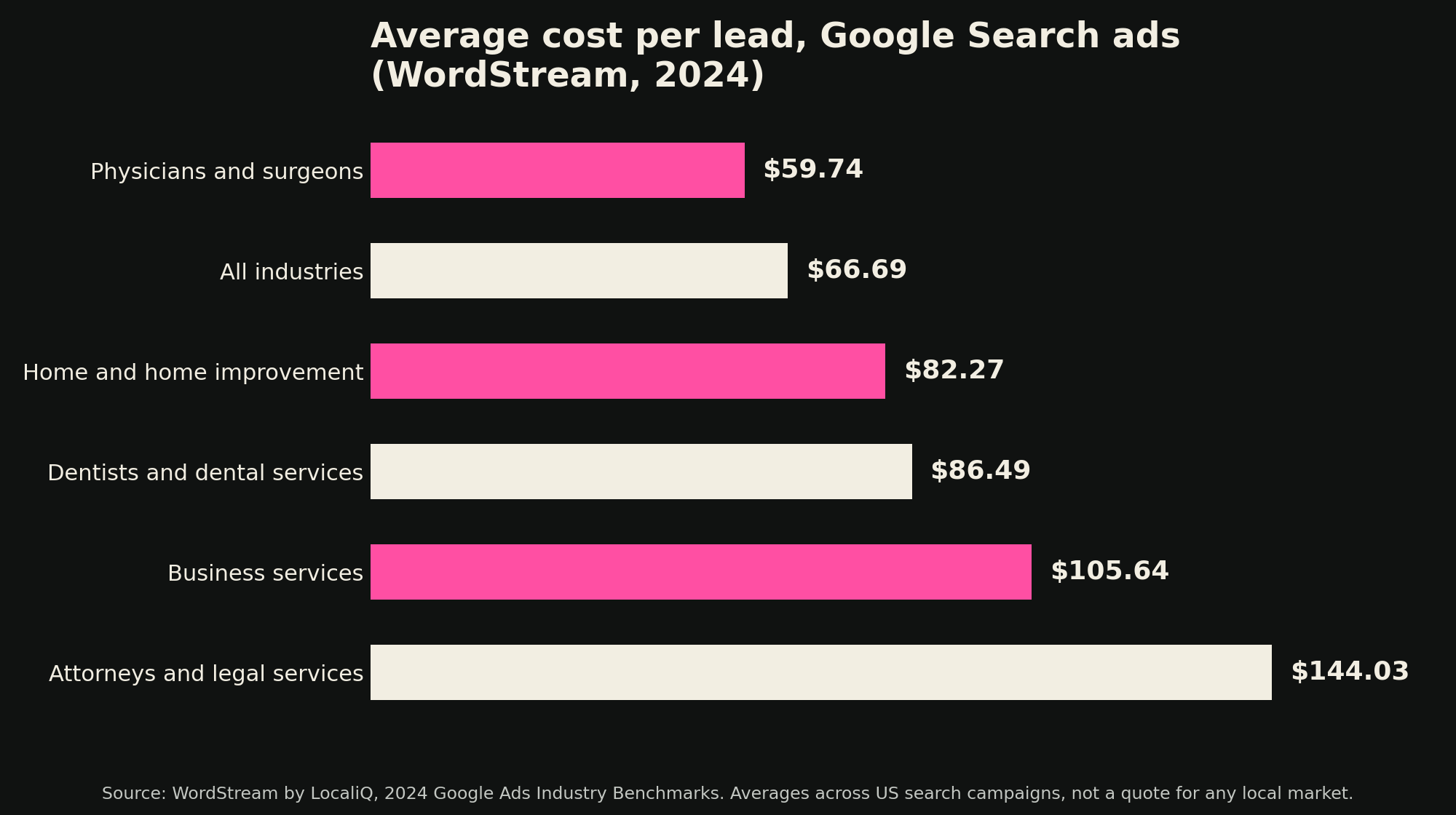
- Home and home improvement: $82.27 — roofers, plumbers, HVAC, electricians, remodelers, landscapers, pest control. The classic lead-machine vertical, and the most competitive ad market in most cities. A straightforward service like pest control or lawn care sits lower; a high-ticket emergency service like HVAC replacement or roofing sits higher. Emergency intent costs more because everyone in town is bidding on the same “AC repair near me” searches at 2 a.m. in July.
- Attorneys and legal services: $144.03 — personal injury, family law, criminal defense, estate planning, immigration. One of the most expensive lead markets in existence, and it’s not close. A single signed personal injury case can be worth tens of thousands of dollars in fees, so firms bid aggressively, and trust friction — a stressed prospect comparing five firms — means fewer raw leads become signed clients, pushing cost per signed case far above cost per raw lead.
- Dentists and dental services: $86.49 — a routine cleaning lead sits lower; an Invisalign consult or implant case sits higher, because the lifetime value of that patient is enormous. A new dental patient isn’t one cleaning; they’re years of cleanings, plus the crown, plus the referral of their spouse.
- Physicians and surgeons: $59.74 — lower than dentistry in this benchmark, again an average that hides the difference between a routine visit and an elective procedure.
- Business services: $105.64 — marketing agencies, IT providers, commercial cleaning, consultants. The band is almost meaningless without context: a commercial cleaning company bidding on office contracts and a managed IT provider chasing 50-seat companies are in the same bucket with completely different economics, because a business owner deciding on an IT provider runs a three-month evaluation, not an afternoon’s choice.
Three drivers explain most of the ranking. First, ticket size: a roof replacement or full HVAC system is a five-figure job, so contractors can afford to pay real money for a lead and still print profit. Second, urgency: when the AC dies or the pipe bursts, the customer isn’t shopping for three weeks — they call whoever shows up first. Third, competition: every contractor in your zip code running the same playbook bids up the price of attention. The spread within home services alone is wide. A gutter cleaning lead and a full kitchen remodel lead are not the same animal and should never be priced the same in your head. Stop asking what “home services CPL” is and start asking what your service line’s CPL is. That’s the number that decides whether your ads are working.
One more caution on these benchmarks: they are Google Search ads only. Meta and TikTok offer cheaper attention but lower intent — you have to manufacture desire with creative and a strong offer. Neither is “better.” High-intent search usually wins for emergency services; social usually wins for considered purchases where you can educate first. Running the wrong platform for your buying cycle is one of the fastest ways to inflate CPL, whatever the benchmark says.
What Drives Your Cost Per Lead Up or Down
Forget benchmarks for a minute. Your CPL isn’t decided by your industry — it’s decided by a handful of levers, and most of them are in your control. Here are the big ones.
Competition density. This is the one you can’t control. Ten roofers bidding on the same keywords in Dallas will pay more per lead than two roofers in a smaller market. Same service, same funnel, different auction. If your CPL feels high, check how crowded your market is before you blame your ads. Sometimes the answer is a better offer or a different channel, not a better ad.
Offer strength. This is the one most businesses ignore. “Call for a free estimate” is not an offer — it’s a chore you’re assigning the customer. A specific, valuable, low-friction offer (“60-second roof inspection quiz — see if you qualify for same-week service”) will convert cold traffic at multiples of a generic contact form. The offer is the single biggest lever on your landing page conversion rate, and conversion rate is the single biggest lever on your CPL. Double your conversion rate and you halve your CPL without touching ad spend.
Landing page and funnel quality. Slow pages, vague headlines, forms with twelve fields, no proof — every one of these leaks money. A quiz funnel that asks three or four engaging questions before requesting contact info typically converts far better than a static “contact us” form, because it gives the visitor a reason to engage before asking for anything. If you want the full breakdown, read our piece on quiz funnels vs. contact forms.
Follow-up speed. This doesn’t change your ad-platform CPL, but it radically changes your effective CPL — the cost per lead that actually turns into revenue. A lead contacted in under a minute converts at a dramatically higher rate than a lead contacted an hour later. Most local businesses still take hours or days to respond. Every minute of delay is money you already spent, evaporating. We wrote a whole post on this: speed to lead.
Seasonality. HVAC leads cost more in the first heat wave. Roofers pay more after hail season. Tax pros pay more in March. Demand spikes bid up auctions, and there’s nothing you can do about the calendar — but you can plan for it. The smart operators increase budgets ahead of peak season instead of reacting to it, and they build retargeting audiences in the off-season when attention is cheap. (More on that in our retargeting guide for local businesses.)
Ad platform choice. Google Search captures high intent and charges for it — expensive clicks, but the person typing “emergency plumber near me” is ready to buy. Meta and TikTok offer cheaper attention but lower intent. Neither is “better.” They’re different tools, and the benchmark figures above are Search only, so don’t compare a social CPL to them directly.
How to Calculate YOUR Target Cost Per Lead
Here’s the part that actually matters. Forget what the average roofer or lawyer pays. The only CPL that counts is the one your business can afford — and you can calculate it with four numbers you already know.
The formula:
Target CPL = Average Job Value × Gross Margin × Close Rate × % of Profit You’ll Spend to Acquire a Customer
Let’s walk through it with a hypothetical roofer. Every number below is made up for illustration — plug in your own.
Step 1: Average job value. Say our roofer’s average roof replacement is $12,000. Not the biggest job, not the smallest — the average, across a year.
Step 2: Gross margin. After materials, labor, and direct job costs, say he keeps 40%. That’s $12,000 × 0.40 = $4,800 of gross profit per job.
Step 3: Close rate. Of every 10 genuine leads, say he closes 2.5 — a 25% close rate. So each lead is worth, on average, $4,800 × 0.25 = $1,200 of expected gross profit. That’s the key insight: a lead isn’t worth the job value. It’s worth the job value times the probability it becomes a job.
Step 4: What percentage of that profit will you spend to get the customer? This is a business decision, not a math problem. Aggressive growth mode might spend 30–40% of gross profit on acquisition. Steady-state might spend 15–20%. Let’s say our roofer is growing and picks 30%. Target CPL = $1,200 × 0.30 = $360.
So: this roofer can pay up to $360 per lead and still hit his profit target. If his actual CPL is $120, he’s printing money and should probably spend more. If it’s $500, his ads are losing money no matter how “cheap” $500 feels compared to some benchmark he read online.
Now run the same math with a conservative 20% acquisition budget: $1,200 × 0.20 = $240 target CPL. Same business, different growth appetite, different number. That’s the point — there is no universal “good CPL.” There’s only your CPL against your economics.
Two things this formula reveals that most owners miss. First, your close rate is a CPL lever in disguise. If our roofer improves his close rate from 25% to 35% — better follow-up, better estimates, better reviews — his expected profit per lead jumps from $1,200 to $1,680, and his target CPL at 30% rises to $504. He can now afford to outbid competitors who close worse than he does. Sales skill literally buys cheaper growth.
Second, this is why you should track cost per booked call alongside raw CPL. If half your leads never pick up the phone, your real economics run on the half that do. Fold your show rate into the close rate and the formula still works — it just tells a harsher, more honest story. For a deeper look at which numbers deserve a spot on your wall, see our marketing dashboard KPIs guide.
The CPL Trap: Cheap Leads That Don’t Close vs. Expensive Leads That Do
Here’s the mistake we see more than any other: a business owner kills a campaign because the CPL went up, or keeps a campaign alive because the CPL is low — without ever checking what those leads actually did.
A $25 lead that never answers the phone is infinitely expensive. You paid for nothing. A $300 lead that becomes a $12,000 job at 40% margin is the best money you’ll spend all year. Raw CPL can’t tell these two apart. It treats them as the same event: a form fill.
This is how the trap works in practice. You run two campaigns. Campaign A generates leads at a low CPL from broad social traffic — lots of names, lots of wrong numbers, lots of “just browsing.” Campaign B generates leads at triple the CPL from high-intent search — fewer names, but they’re homeowners with a burst pipe and a credit card. If you optimize for CPL, you kill B and scale A. Congratulations: you just optimized your way into bankruptcy.
The fix is to push your reporting one level deeper. Track CPL, sure — but also track cost per qualified lead and cost per booked call. The moment you see that Campaign B’s cost per booked estimate is actually lower than Campaign A’s, the decision makes itself. The campaign with the higher CPL was the cheaper campaign all along.
This is also why lead quality has to be a feedback loop, not a one-time setup. Your ad platform will happily find you more of whatever you tell it a “conversion” is. If you tell it a conversion is a form fill, it finds form-fillers. If you feed back actual booked calls or closed jobs — even manually at first — it starts finding buyers. The businesses with the best CPLs aren’t lucky. They’re just measuring the right event.
How to Lower Your Cost Per Lead Without Spending More
You don’t need a bigger budget. You need fewer leaks. Here’s where the leaks usually are, in order of impact.
Fix the offer first. Before you touch targeting, creative, or budget, look at what you’re actually asking the visitor to do and what they get for doing it. “Contact us” is not an offer. A specific promise with a clear next step is. Strong offers routinely double or triple conversion rates, which cuts CPL by half or more at the same spend. This is the highest-leverage change most local businesses can make, and it’s free.
Upgrade the funnel. If you’re still running a static contact form, you’re leaving money on the table. An interactive quiz — three or four questions about the visitor’s situation, then the contact step — gives people a reason to engage and pre-qualifies them at the same time. Higher conversion, better lead quality, lower effective CPL. The full comparison is in our quiz funnel vs. contact form breakdown, and if you want to see one working in the real world, here’s a live lead-machine demo.
Answer the phone. We keep saying it because nobody does it. Call new leads in under a minute, follow up five-plus times across call, text, and email, and watch your cost per booked call drop without spending a dollar more on ads. Most of your competitors give up after one attempt. Outlast them. The details are in our speed-to-lead guide.
Put proof everywhere. Reviews, before-and-afters, real numbers, real faces. Cold traffic doesn’t trust you yet, and trust is the tax every unknown business pays in conversion rate. Every piece of credible proof on your landing page lowers that tax. This is also why your Google Business Profile matters — a chunk of your prospects will check your reviews before they ever fill out your form.
Tighten targeting before you widen it. A smaller, sharper audience with a message written specifically for them will almost always beat a big generic audience. “Homeowners in these five zip codes with roofs over 15 years old” beats “homeowners.” Specificity converts, and conversion is what lowers CPL.
Retarget the almosts. Most of your visitors won’t convert on the first visit. That’s normal. What’s not normal is letting them leave forever. A simple retargeting campaign aimed at people who started your quiz or visited your booking page — but didn’t finish — is typically the cheapest CPL in your entire account, because the audience already knows you. Our retargeting guide for local businesses walks through the setup.
Test creative like it matters — because it does. Ad fatigue is real. The same creative running for months will slowly bleed efficiency as your audience tunes it out. You don’t need a production studio; you need a steady rotation of simple, honest variations — new hooks, new proof, new angles on the same offer. Fresh creative is maintenance, not a luxury.
Frequently Asked Questions
What’s a good cost per lead for a small business?
There isn’t one — and anyone who gives you a single number is selling something. A good CPL is any number below your target CPL, which you calculate from your average job value, gross margin, close rate, and how much of your profit you’re willing to spend on acquisition. A $400 CPL is fantastic for a lawyer signing five-figure cases and catastrophic for a lawn care company. Run your own math; that’s the only benchmark that matters.
Why is my cost per lead higher than a friend’s in the same industry?
Usually one of four things: a more competitive market, a weaker offer, a lower-converting funnel, or slower follow-up. Two businesses in the same vertical can have wildly different CPLs because CPL is set by the auction and your conversion rate, not by the industry alone. Before you worry, check whether your friend is measuring the same thing — raw leads vs. qualified leads vs. booked calls. Half of all CPL arguments are just people comparing different numbers.
Should I just buy leads from a lead broker instead of running ads?
Sometimes, as a supplement — rarely as your whole strategy. Brokers sell the same lead to multiple buyers, so you’re racing competitors to the phone, and you don’t control the quality, the targeting, or the price. Running your own lead machine costs more upfront in time and testing, but you own the asset: the audience, the funnel, the data, and a CPL that improves instead of inflating. Most businesses we see do best with owned lead flow as the core and brokered leads as overflow.
Is a cheaper cost per lead always better?
No — and chasing the cheapest CPL is one of the most common ways to lose money in advertising. A cheap lead that doesn’t close costs you infinitely more than an expensive lead that does. Optimize for cost per qualified lead and cost per booked call, not raw CPL. The campaign with the lowest CPL is very often the campaign producing the worst customers.
How long does it take to know my real cost per lead?
Longer than most people think. You can see a directional CPL within a couple of weeks of consistent spend, but your true CPL — the one tied to closed revenue — takes a full sales cycle plus follow-up to reveal itself. If your sales cycle is 30 days, don’t judge a campaign at day 10. Give it enough budget to produce a meaningful sample of leads, let them work through your pipeline, then judge on cost per booked call and cost per closed job. Patience here is a competitive advantage, because most of your competitors will quit too early.
Sources
- WordStream by LocaliQ, 2024 Google Ads Industry Benchmarks (US search campaigns) — all-industry average cost per lead $66.69; home and home improvement $82.27; attorneys and legal services $144.03; dentists and dental services $86.49; physicians and surgeons $59.74; business services $105.64. Search-ad averages only, not a quote for any local market, and not comparable to social or brokered lead costs.
- Note: The roofer example in the target-CPL section ($12,000 job, 40% margin, 25% close rate, $360 target at 30%) is the post’s own worked hypothetical, unchanged from the original, and is labelled as such in the text. It is not benchmark data.
Want this built for you?
We build you a lead machine with a known cost per lead — then report it on one dashboard every month, down to the dollar.