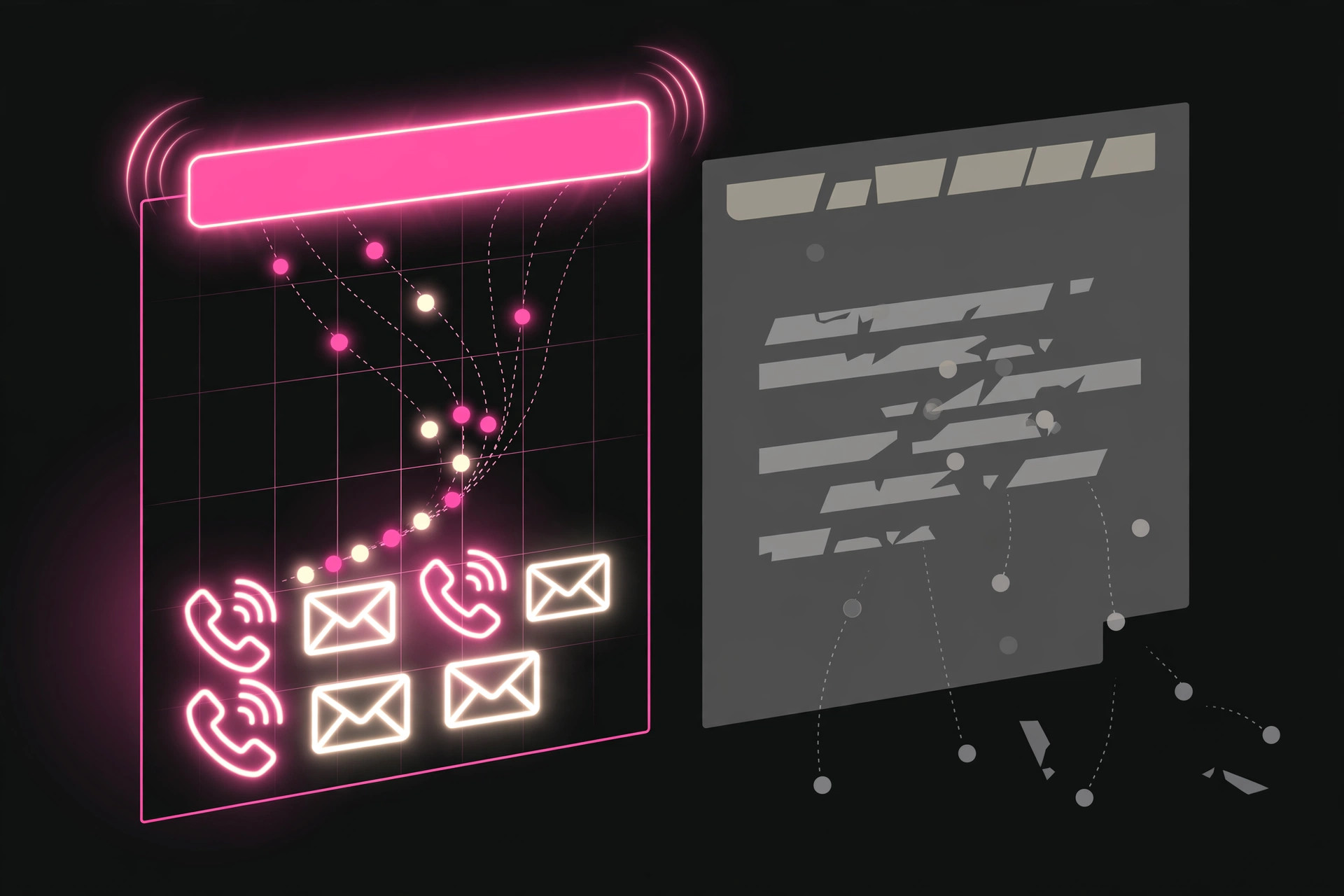
The short answer: Your homepage headline is the highest-leverage sentence on your website — it decides, in seconds, whether a visitor reads on or bounces back to Google. Research from the Nielsen Norman Group shows visitors often leave pages in 10–20 seconds, and that communicating your value proposition within 10 seconds is what separates pages that hold attention from pages that don’t. A VWO case study found that swapping a vague headline (“Businesses grow faster online!”) for a plain, descriptive one (“Create a webpage for your business”) increased conversions by 90%. The formula that wins for local service businesses is simple: name the service, name the city, name the outcome, and make the next step obvious — then let your sub-headline and proof do the rest.
 Clear headlines convert. Confusing ones don’t. The difference shows up in your quote-request rate.
Why your homepage headline is your highest-leverage sentence
David Ogilvy’s most famous line about copywriting is also the one most business owners ignore: on average, five times as many people read the headline as read the body copy. When you write your headline, Ogilvy argued, you have spent most of your money — the headline is what decides whether anyone reads the rest.
That was written for print ads decades ago, and the web has only made it more true. The Nielsen Norman Group found that web users read only about a quarter of the text on the pages they visit, and they often leave within 10–20 seconds. The headline isn’t the opening line of your website. For most visitors, it’s the whole website. It’s the sentence that either earns the next ten seconds of attention or sends the visitor back to the search results, where your competitor’s headline gets the same ten-second audition.
Now put a number on that audition. Unbounce’s 2024 Conversion Benchmark Report — 41,000 landing pages, 464 million visitors, 57 million conversions — puts the median landing page conversion rate at 6.6% across industries. That median is the middle of everything: good pages and bad, clear headlines and confusing ones. The pages at the top of the distribution aren’t getting there with better traffic. They’re getting there with clearer first screens, and the headline is the first thing on the first screen.
For a local service business, the stakes are more concentrated than in ecommerce or SaaS. You don’t need a visitor to browse. You need them to do one of two things: call you or request a quote. Everything above the fold — the headline, the sub-headline, the phone number, the button — exists to make that one action feel obvious and safe. The homepage headline is the lever that moves the whole thing.
This is why the headline deserves more thought than the entire rest of the homepage combined. A new photo gallery won’t save a headline that confuses people. A faster page won’t save a headline that says nothing. But a headline that tells a stranger exactly what you do, for whom, and what happens next — in five seconds — makes every other asset on the page work harder: the reviews, the photos, the form, the click-to-call button.
The 10 seconds that decide everything
There are two pieces of research every local business owner should know, because together they describe exactly how much room your homepage headline has to work.
The first is from the Nielsen Norman Group’s long-running research on page stays: users often leave web pages in 10–20 seconds, but pages with a clear value proposition can hold attention for much longer. NN/g’s conclusion is blunt: to gain several minutes of user attention, you must clearly communicate your value proposition within 10 seconds. Ten seconds. That’s not the time you have to tell your story — it’s the time you have to tell people what you sell.
The second shrinks the window even further. In a 2006 study published in Behaviour & Information Technology, researchers led by Gitte Lindgaard at Carleton University showed people web pages for just 50 milliseconds and asked them to rate their visual appeal. Those split-second ratings closely matched the ratings from people who had much longer to look. The study’s conclusion: web designers have about 50 milliseconds to make a good first impression. Fifty milliseconds — before a single word is read — the visitor has already formed a feeling about your page. If that feeling is “cluttered” or “confusing,” they start reading with less goodwill, if they read at all.
Put the two together and the sequence is this: at 50 milliseconds, the visitor feels something about your page. By 5 seconds, they’ve scanned the headline and decided whether you sell what they need. By 10 seconds, your value proposition has either registered or it hasn’t. After that, they’re either reading with interest or they’re gone.
Now look at what most local business homepages put in front of that sequence. The typical hero section leads with the business name in big type — “Johnson & Sons Plumbing” — followed by a tagline like “Quality you can trust since 1998” or “Your neighborhood experts.” Read that through the 5-second scan: the visitor learns a family name, a founding date, and a claim every plumber makes. They do not learn what you do (plumbing — actually yes, buried in the name), where you do it, what it costs, how fast you show up, or what to do next. The headline spent the only sentence most people read telling them things they don’t need to decide.
The cruel part: none of this is anyone’s fault. “Quality you can trust” is what marketing sounded like for fifty years. It just doesn’t survive the 10-second test, because it’s not a value proposition — it’s a slogan. A value proposition answers three questions, and Donald Miller laid them out better than anyone in Building a StoryBrand: within five seconds, a first-time visitor should be able to answer (1) what do you offer, (2) how will it make my life better, and (3) what do I need to do to buy it. Miller calls this the “grunt test”: could a caveman look at your website and grunt what you offer? It’s funny, but it’s deadly serious. If the headline fails the grunt test, everything below it is invisible.
What a failing homepage headline actually looks like
Most failing headlines fail in one of two ways. Learn to spot them, because one of them is probably on your site right now.
Failure mode #1: Clever but empty
These are the tagline-style headlines: “Where Quality Meets Comfort,” “Excellence Is Our Standard,” “We Treat You Like Family.” They sound like marketing. They contain zero information. A homeowner with a leaking water heater scanning your page for five seconds gets nothing from “Where Quality Meets Comfort” — no service, no city, no reason to believe you’re the answer to the problem that’s currently flooding their garage.
The test is simple: delete your business name from the headline and ask whether a stranger would know what you sell. “Where Quality Meets Comfort” could be an HVAC company, a mattress store, a spa, or a bed-and-breakfast. If your headline could belong to any business in any industry, it belongs to none of them. It’s wallpaper.
Illustrative example of the fix: imagine a plumber whose headline reads “Plumbing Excellence Since 1998.” Nothing wrong with the business — but the headline says when they started, not what the visitor gets. The rewrite: “Same-day plumber in Raleigh. Fixed right, priced upfront.” Service, city, outcome, and a friction-killer (upfront pricing) in eight words. The grunt test passes: a caveman grunts “plumber, Raleigh, fast, honest price.”
Failure mode #2: Feature soup
The opposite failure: headlines that list credentials instead of outcomes. “Licensed, Bonded & Insured | Residential & Commercial | 24/7 Service.” These read like the side of a work van, and they make the same mistake from the other direction — they answer questions the visitor hasn’t asked yet. Nobody with a burst pipe is comparing bond status. They’re comparing who will show up today and whether they’ll get ripped off.
Credentials matter — but they belong in the sub-headline, the trust badges, or the reviews section, where they support a decision the headline already started. The headline’s job is to win the first five seconds. The credentials’ job is to close the sale over the next five minutes. Don’t make the headline do the credentials’ job.
Illustrative example: a roofing company whose headline reads “GAF Master Elite® Certified Roofing Contractor.” Accurate. Impressive to roofers. Meaningless to a homeowner who just wants to know if you’ll replace their storm-damaged roof this month. The rewrite: “New roof in as little as one day — backed by a 25-year warranty.” The certification can go right underneath as a trust badge. The headline sells the outcome; the badge proves the competence.
Both failure modes share a root cause: the headline was written for the business, not for the visitor’s five-second scan. The owner knows what the business does, so the headline feels obvious to them. But the headline isn’t for the owner. It’s for a stranger on a phone, in a driveway, with a problem, who will give it five seconds before trying the next result. Write for that person.
The proof that homepage headlines move real numbers
This isn’t taste or theory. Headlines have been A/B tested more than almost any other element on the web, and the results consistently reward clarity over cleverness.
CityCliq: +90% from saying what it sells
The cleanest headline test in the public record comes from CityCliq, a provider of low-cost business web pages, documented by VWO. They tested four headline variations on their homepage for two weeks, with click-through to pricing as the conversion goal:
- “Businesses grow faster online!” (the original)
- “Online advertising that works!”
- “Get found faster!”
- “Create a webpage for your business”
The winner wasn’t the punchiest or the most benefit-driven. It was the plainest: “Create a webpage for your business” — the most direct, descriptive statement of what the company actually sells. It beat the original by 90%, and the result was statistically significant. The three losing headlines all tried to sell an outcome (“grow faster,” “works,” “found faster”). The winner just said the thing. Clarity beat persuasion.
There’s a lesson in that for every local business: your visitors arrived with intent. They searched “emergency plumber near me” or “roof replacement cost.” They don’t need to be persuaded that plumbing matters. They need to know, in five seconds, that you are the plumber they searched for. The headline that wins is usually the one that matches the searcher’s intent most literally.
Highrise: +102.5% from radical simplification
In a widely cited case study from Conversion Rate Experts, the CRM company Highrise replaced its busy homepage with a radically simple page: the top navigation removed, most of the text and video cut, one large photo of a real happy customer with a concise quote, three short feature bullets, and one big call-to-action button. Paid signups increased 102.5%.
That wasn’t a headline-only test — it was a whole first-screen redesign. But the headline was the centerpiece of the change: instead of the company talking about itself, one customer talked about the outcome. The page stopped selling software and started selling the result, in the customer’s own words. For a local business, the equivalent is simple: your best headline might not be written by you at all. It might be a customer’s sentence — “They fixed it the same day and the price was exactly what they quoted” — sitting where your tagline used to be.

The benchmark that keeps everyone honest
Remember the Unbounce number: a 6.6% median landing page conversion rate. That’s the middle of the market. The headline tests above — 90% lifts, doubled signups — are what moving from the middle toward the top looks like. You don’t need to beat the median by being brilliant. You need to beat it by being clear, because most of the market is still running clever-but-empty or feature-soup headlines. Clarity is a competitive advantage precisely because it’s rare.
How to write a homepage headline that gets quote requests
Everything above is diagnosis. Here’s the prescription — the working method for writing a homepage headline that turns visitors into quote requests, built for local service businesses.
Step 1: Run the 5-second grunt test on your current headline
Before you write a word, test what you have. Open your homepage on your phone, show it to someone who doesn’t know your business, and take it away after five seconds. Then ask three questions — Miller’s three:
- What do we sell?
- How would it make your life better?
- What would you do next to buy it?
If they can’t answer all three, your headline is failing, no matter how much you like it. Most local business headlines fail question one or two. “Johnson & Sons” answers neither. “Quality you can trust” answers neither. This test takes thirty seconds and it has ended more debates about homepage copy than any analytics dashboard ever will.
Step 2: Put the service and the city in the headline
This is the single highest-ROI change most local businesses can make. The visitor arrived from a search that almost certainly included a service and a place: “AC repair Tampa,” “landscaper near me,” “divorce lawyer Austin.” Your headline should mirror that intent back to them. When the headline matches the search, the visitor’s brain registers “right place” in the first second of the scan — and everything after that gets read with goodwill instead of skepticism.
You don’t have to be literal to the point of ugly. “Same-day AC repair in Tampa” is a headline. “Tampa’s same-day AC repair crew” is a headline. What doesn’t work is making the visitor infer the service from your business name or infer the city from your area code. Every inference is a chance to lose them, and you only have five seconds of chances.
Step 3: Sell the outcome, then kill the objection
After the service and city, you have a few words left. Spend them on the outcome the customer wants, plus the objection that’s stopping them from calling. The pattern is: [service] in [city]: [outcome], [objection killer].
Illustrative examples of the pattern in action:
- Plumber: “Same-day plumber in Raleigh — fixed right, priced upfront.”
- Roofer: “Storm-damage roof replacement in Charlotte — done in a day, backed for 25 years.”
- HVAC: “AC repair in Tampa today — $89 diagnostic, no surprise fees.”
- Landscaper: “Weekly lawn care in Plano — show up on time, every time, or it’s free.”
- Electrician: “Licensed electrician in Denver — most jobs finished same visit.”
Notice what each one does: it names the thing, names the place, promises the outcome (today, done in a day, same visit), and defuses the fear (priced upfront, backed for 25 years, no surprise fees). These are illustrative templates, not real businesses — but the structure is the point. Write yours in the same shape and you’ll pass the grunt test on the first draft.
Where do the objections come from? From your own phone calls. Ask whoever answers your phones what worried callers ask about before booking: price, timing, mess, whether you’ll actually show up. Those worries are your objection killers. The headline is where the biggest one goes; the rest go in the sub-headline and the FAQ section.
Step 4: Make the next step impossible to miss
Miller’s third question — what do I need to do to buy it? — is where most local homepages quietly fail. The headline promises, the sub-headline explains, and then… a tiny “Contact” link in the nav. The visitor has to hunt for the action.
The headline and the call-to-action are a unit. Directly under or beside the headline, there should be exactly one primary action, and it should say what happens next in the visitor’s language: “Get my free quote,” “Call (555) 123-4567,” “See pricing.” Not “Submit.” Not “Learn more.” The button is the answer to question three, and it should be visible without scrolling on a phone.
This pairs directly with speed to lead: the headline’s job is to get the visitor to act within seconds, and your follow-up system’s job is to respond within minutes. A great headline feeding a slow follow-up is a leaky bucket — which is why the headline and the response system have to be designed together.
Step 5: Let the sub-headline do the supporting work
One of the reasons headlines get bloated is that owners try to make one sentence do five jobs. Don’t. The headline does one job: pass the 5-second scan. The sub-headline — the smaller line right beneath it — does the next three jobs: add the proof, add the differentiator, and repeat the call to action in longer form.
Working structure:
- Headline: service + city + outcome + objection killer (under ~12 words)
- Sub-headline: one sentence of proof or differentiation (“4.9 stars from 600+ neighbors” is illustrative — use your real numbers) plus what happens after they reach out (“Free estimates, usually same-day.”)
- Button + phone: the single next step, visible without scrolling
Notice the reviews number above is illustrative — never invent review counts, ratings, or testimonials. Use your real numbers or say nothing. A fabricated “4.9 stars” that a visitor can’t find on your Google profile destroys more trust than a missing number ever could. Our review engine guide covers how to build the real numbers systematically.
Where the homepage headline fits in the lead machine
A great homepage headline doesn’t work alone. It’s the first component of a system, and it has a specific job in that system: convert arriving attention into an action. Here’s how it connects to the rest.
Headline → capture. The headline earns the click on your call button or quote form. But the form it leads to matters just as much — a brilliant headline that dumps visitors into a twelve-field contact form wastes the win. If you’re seeing traffic but no calls, our traffic-without-calls diagnostic walks through the leaks in order. And consider whether a quiz funnel would capture more of the visitors your new headline persuades — an engaged visitor who just read a clear headline is the perfect candidate for a two-minute quiz instead of a cold form.
Capture → speed. The headline creates the lead; speed to lead keeps it. A visitor who acted on your headline’s promise of “same-day” service and then waits six hours for a callback learns that the headline was marketing, not a promise. The headline sets the expectation; the follow-up system has to meet it.
Proof → headline. The relationship runs both ways. Your best future headlines will come from your reviews — the exact words customers use to describe the outcome. Mine your five-star reviews for sentences that pass the grunt test, and promote the best ones into the hero section. That’s how the lead machine compounds: proof feeds the headline, the headline feeds capture, capture feeds reviews, reviews feed the headline.
Think of the headline as the front door of the machine. Everything behind the door — the capture, the follow-up, the nurture, the proof — is what turns a quote request into revenue. But nobody walks through a door they can’t find, and on a homepage, the headline is the door.
Frequently Asked Questions
How long should a homepage headline be?
Short enough to pass the 5-second scan — for most local service businesses, that’s under about 12 words. The Nielsen Norman Group’s research shows visitors decide within 10–20 seconds whether a page deserves their attention, and eye-tracking studies consistently show they read in an F-pattern, catching the headline and the first words of each line. If your headline needs a second breath to read, it’s too long. Put the overflow in the sub-headline.
Should my business name be the homepage headline?
No — your business name should be in the logo and the header, not the headline slot. The headline slot is the most-read sentence on your site (Ogilvy’s 5x rule), and spending it on your own name wastes it: the visitor already sees your name in the logo. Use the headline for what the visitor doesn’t know yet — what you do, where you do it, and why they should call you instead of the next result.
What is the grunt test for a website headline?
The grunt test comes from Donald Miller’s Building a StoryBrand. Within five seconds of landing on your site, a first-time visitor should be able to answer three questions: what do you offer, how will it make my life better, and what do I need to do to buy it? Miller frames it memorably: could a caveman look at your website and grunt what you offer? If the headline passes, visitors stay. If it fails, they bounce — usually within the 10–20 second window the Nielsen Norman Group measured.
Do headlines really affect conversion rates that much?
Yes — headlines are among the most A/B-tested elements on the web for a reason. In VWO’s documented CityCliq test, changing the homepage headline from “Businesses grow faster online!” to the plainer “Create a webpage for your business” increased conversions by 90%, a statistically significant result over a two-week test. In Conversion Rate Experts’ Highrise case study, rebuilding the homepage around one clear customer story and a single call to action increased paid signups by 102.5%. Against Unbounce’s 6.6% median landing page conversion rate, those are the kinds of lifts that move a business from the middle of the market toward the top.
Should I include my city in my homepage headline?
Almost always, yes. Most of your visitors arrived from a search containing a service and a location, and mirroring that intent back in the headline tells their brain “right place” within the first second of scanning. It also differentiates you instantly from national directories and competitors in other markets. The exception: if you genuinely serve a national audience with no local intent, lead with the outcome instead — but for local service businesses, city-in-headline is the default.
How do I know if my new headline is working?
Watch two numbers: bounce rate on the homepage (or better, the percentage of homepage visitors who take the primary action) and your quote-request or call volume from the site. Give a new headline at least a few hundred visitors before judging — small samples lie. If you have enough traffic, A/B test the old headline against the new one with a tool like VWO or Google Optimize’s successors; the CityCliq test ran for two weeks to reach significance. If traffic is thin, the 5-second grunt test with real strangers is a surprisingly good proxy: if they can’t answer Miller’s three questions, the headline isn’t working regardless of what the analytics say.
Sources
– Unbounce, 2024 Conversion Benchmark Report — 41,000 landing pages, 464 million visitors, 57 million conversions; median landing page conversion rate 6.6% across industries.
– Nielsen Norman Group, research on how users read on the web — users scan rather than read word-by-word, reading roughly a fifth of the text on an average page; visitors often leave within 10–20 seconds, as cited in the post.
– Conversion Rate Experts, Highrise case study (as cited in the post; not independently verified in this audit) — a simplified homepage increased paid signups by 102.5%.
– VWO case study and Lindgaard et al. (Carleton University, 2006), as cited in the post and not independently verified in this audit — a plain headline lifting conversions by 90%, and 50-millisecond first-impression ratings.
– Note: The case-study lifts are single-company results, not benchmarks. Where a figure comes from a roundup rather than a single primary study, it is listed as such above.
Want this built for you?
Your homepage headline is one sentence. But the right sentence only works inside the right system — capture, instant follow-up, nurture, and proof — so every visitor your headline persuades actually becomes revenue.